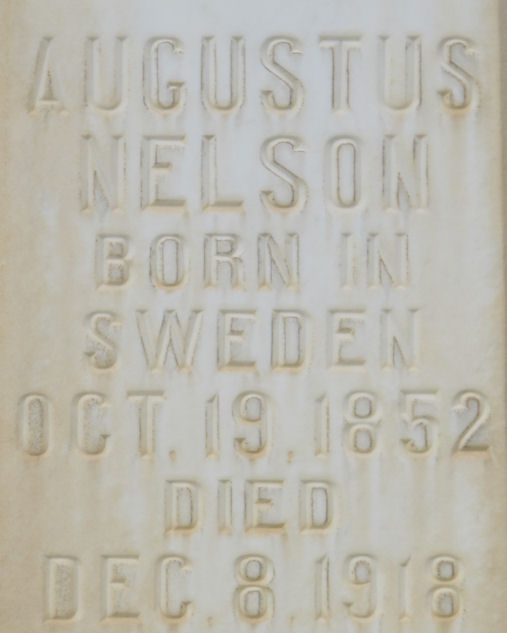
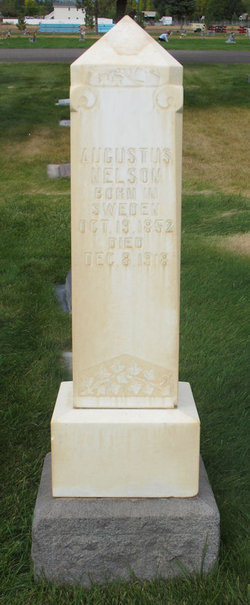
Showing posts with label Augustus Nelson. Show all posts

Sunday, September 26, 2010

Augustus Gustave Nelson 1851 - 1918


Augustus was born 

21 Oct 1851

in Novidinge, Malmus, Sweden


Parents:

Father: Hans Nelson


Augustus married 

 Ann Catherine Porter 
  
19 Apr 1876 in Salt Lake City, Utah


Augustus died 9 Dec 1918 

in Mt. Pleasant, Utah


August Nelson


Plot: A_19_4_8


Augustus and Ann Catherine's Children


Olivie Nelson
B: 21 Jan 1877
M: Lawrence O. Winters
D: 14 Nov 1955

Ada Ann Nelson
B: 3 Oct 1879
M: William Arthur Matson
D: Aug 1968


Mary Augusta Nelson
B: 6 Oct 1881
M: Arthur Olef Neilson Plot: A_26_1_8
D: 10 Aug 1909
Plot: A_19_4_3


Baby Girl Nelson
B: 1883
D: 1883


Hans Buchanan Nelson
B: 29 Dec 1884
M: Luzene Pearson
D: 15 Feb 1960
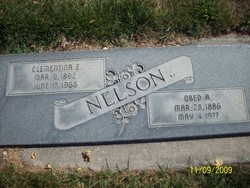

B: 28 Mar 1886
M: Clementine Marian Ericksen
D: 2 May 1977


B: 18 Feb 1888
M: Talula Johanna Frandsen
D: 23 Apr 1962
 Mt. Pleasant Cemetery Plot: B_3_3_8


Evan Leslie Nelson
B: 5 Jan 1890
M: Lois Kay
D: 27 Oct 1929
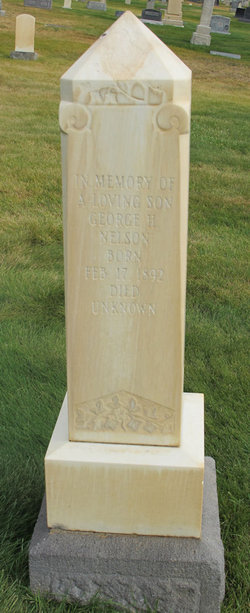


George Henry Nelson 
George Henry Nelson
B: 17 Feb 1892
D: 16 Oct 1984


Hugh Devere Nelson
B: 19 Oct 1894
M: Sarah Maudella Larsen
D: 24 Jan 1968


B: 25 Jan 1898
D: 2 Jun 1988
Mt Pleasant Cemetery Plot: A_19_1_3


Frank Douglas Nelson
B: 14 Jun 1901
D: 17 Nov 1938
Mt. Pleasant Cemetery Plot: A_19_1_2


Photos of Augustus and Ann Catherine's Children

Augustus and Ann Catherine's Children

Olivie Nelson and Ada Ann Nelson


Mary Augusta Nelson


Helen Arvilla Nelson


 The Nelson Brothers
(Left to Right)

Obed, Frank, Evan, Hans, George, Hugh, Edgar

Augustus and Ann Nelson's LDS Ordinances

Augustus Gustave Nelson's
LDS Ordinances

Baptism: 1 Oct 1862
Confirmation: 1 Oct 1862

Initiatory: 19 Jun 1876
Endowment: 19 Jun 1876
Endowment House

Sealed to Parents: 18 Jul 1894
Manti Temple

Sealed to Spouse, Ann Catherine Porter
19 Jun 1976
Endowment House


Ann Catherine Porter's
LDS Ordinances

Baptism: 7 Oct 1867
Confirmation: 7 Oct 1867

Initiatory: 19 Jun 1876
Endowment: 19 Jun 1876
Endowment House

Sealed to Parents: Born in the Covenant

Sealed to Spouse, Augustus Gustave Nelson
19 Jun 1876
Endowment House

Augustus and Ann Catherine Nelson's Death Certificate

August Nelson's Death Certificate
(his Death is dated 8 Dec 1918 on his Death Certificate)


Ann Catherine's Death Certificate


Saturday, September 25, 2010

Life History of Augustus

Life History of Augustus Gustave Nelson

Augustus Gustave, known to his friends as A.G. was born 21 October, 1851 in Norrvidinge, Malmus Sweden. The son of Hans Nilsson and Olive Poulson (Dehlin). This Swedish father was an excellent farmer and made a good living for his family of six children in Sweden.

When Augustus was ten years old, the Mormon Missionaries converted the family to the Latter-Day Saint religion. They were naturally religious and soon found the principles of the new church suited their beliefs and gave them new freedom of worship. Mormons were not popular so they found themselves without friends and the urge to go to Zion became very strong. The decision to go was made and they sold their home and farm and booked passage for America. They left behind all that had been dear to them.

The trip across the ocean was a long tragic one. Three months of rough seas and many storms. The lack of good drinking water, poor food, and impure air impaired their health. When about half-way across the ocean, measles broke out among the passengers. The children suffered most as there was no room to quarantine the sick. Their low vitality caused the disease to be extremely hard. The Nelson children were all sick at the same time, giving the parents no time for special care or rest. Three of the children died and one was left almost blind. It is hard to visualize the depth of their sorrow as the bereaved parents watched while their fifteen-year old son, Anders, almost a man, was tied in a blanket and slid down the plank into the rough black water. Most of the burials were done at night to save the passengers the terrible ordeal of watching a loved one swallowed up in the cold uncaring sea. A few days later his sister, Anna, a young woman of thirteen years followed Anders into the awful watery grave. Mary survived the disease but her eyes were affected by the high fever and the tragedy of blindness seemed imminent. The darling baby Henrik seemed to be recovering when a sudden change snatched him away. All their efforts were in vain. No words can express the anguish of these loving parents. Now all their attention was given to Mary. Her life was spared but she could no longer see and needed to be guided where ever she went. Out of the six children, Anders, Anna, and Henric died. August, Mary and Nels came to Mt. Pleasant, Utah.

Their trek over the plains was much the same as others. Ox teams carried them to Utah and in due time, they arrived in the Salt Lake Valley. Mary's eye sight was beginning to come back, but she was partially blind the rest of her life. The family found their way to Mt. Pleasant in 1863, where they became farmers using their knowledge and experience from Sweden.

On the nineteenth of April, 1876, Augustus married a lovely young lady, Ann Catherine Porter. They traveled to Salt Lake in a wagon, taking two days to make the trip, to be married in the Endowment House. Ann told the story of how she carried on her lap a basket of dried apples and plums to Eliza R. Snow. She was thrilled to be of service to her.

 
Augustus took up a quarter section of land three miles west of town with Christian Peel. Each man took half. Each built a log house and a log grainery. The logs were hauled by ox team from the mountains east of town, and each man helped the other. They had to carry water from a spring at the foot of the hill up to their homes until a pipe was driven into the ground to make a flowing well of delicious cold water. This well produced enough water for home and garden use as well. To keep milk, butter, and eggs cool a box was placed over the water with a burlap sack which absorbed water and allowed fresh air to cool and circulate. This "cool box" as it was called was used for many years.

Cattle did well on the large meadows. Pigs and chickens helped to supply food along with the garden produce. Grain was raised on the rich fertile fields.

Twelve children were born to this humble home. One died in infancy, eleven reached maturity. The log home became too small. so a four rooms of red brick were added to the log home.

The children were educated in a one room school house two miles west of their home. As education was emphasized in their home, the older girls, Olivia, Ada and Mae, as they reached college age were allowed to go to the Brigham Young Academy in Provo. They stayed in homes and worked their way. Here they learned to sew and along with their mothers help they became expert dressmakers. Ada also became a school teacher.

Augustus saw a good opportunity for his growing boys to go into the sheep business. He went into partnership with Andrew Larsen. As the business grew the Nelson brothers purchased more ground and went into the sheep business of their own. This became their life's work.

About 1900, Augustus was stricken with arthritis or rheumatism as it was called. He became confined to his rocking chair, used in place of a wheel chair, for the rest of his life. This interrupted the schooling of the boys as now they were required to do all the farm work. They could get about five months of schooling in the winter as fall and spring were busy times on the farm.

In 1906 the family built a beautiful brick home at First North and Fifth West. Here the abundant life of the family was enjoyed. Memories remind us of marriages, graduations, birthday parties, Christmas celebrations and the homecoming of two sons, Hugh and George from World War I. December 9, 1918, during the terrible flu epidemic, Augustus passed away. He left behind him a better place. He was proud of his large family of fine men and women. He left much improved farm land and good livestock.

During his illness, he guided his family from his big rocking chair. He kept track of appointments such as water turns, also sheep camp supplies, and finances.

All his life he remembered, but talked little of the terrible tragedy when crossing the ocean. An impression on a ten year old boy, he never forgot.


Nelson Brothers by Roxey Washburn

Grandfather Augustus Gustave Nelson was among the early pioneers that settled Utah. He was just a small boy as his family crossed the ocean headed for Utah and finally settling in Mt. Pleasant. He took up a farm three miles west of Mt. Pleasant where he and his bride Ann Catherine Porter built a small log home, to which they later, added a larger brick portion to accommodate their increasing family.

As the sheep industry started to take hold in the Sanpete area, Augustus or A.G., as he was more commonly known, decided to invest in sheep along with Andrew Larsen. This was ideal for his family of seven boys and four girls.


It wasn't long until A.G. was stricken with Rheumatism Arthritis as we know it. As the painful disease took over his body he was confined to bed of a rocking chair used as a wheel chair, but, he continued to oversee and give direction to his young sons.


As the boys got older they increased their herd and went on their own as a family becoming known as the "Nelson Brothers", Cannon, Edgar, Evan, Obed, Hugh, George and Frank.


The Nelson Brothers were reaching the age of getting married and having their own families. When it became available for them to acquire "Homesteads", through the Homestead Act. They were required to "Prove Up" on this ground by living on it and making improvments for 5 years. Each brother was ale to do this.


Typical of "Proving Up", was Edgar and his wife Talula and their family. They spent five summers on the Homestead, enjoying the beautiful mountains near Cotlon, Utah. They built a log cabin from native trees, fences, roads, there own bridges across the washes so they could get in easier, as well as many other improvements.


The children enjoyed the beautiful mountains, riding horses, making squirrel cages, chipmunk traps, cutting their names in the trees and gathering wild flowers and mushrooms. One time they even built a house for the dog and six puppies.


These homesteads became lambing grounds and summer feed for part of their sheep. They were also able to get summer range permits on the mountain and winter range in the west desert. These areas all became like second homes to their family as they spent many weeks and months herding the sheep and enjoying the beauties of nature. There were always new trails to explore, fishing holes to be fished and lambs to be tended.


Then the "Great Depression" hit. Many of the men were going broke, loosing everything they had. They were unable to sell their wool or the lambs so they could meet their obligations. The Nelson Brothers, were able to mortgage their sheep to a bank that would give them $10.00 a month to live on.


The Nelson Brothers pulled together, they did their own herding while their families took care of their homes and their small farms, raising gardens to take care of their food and do what they could to make it through the years.


Talula raised a beautiful garden, tomatoes and carrots were taken to the school to exchange for us children to get a bowl of soup to go with our dry sandwiches, if we were lucky enough to have a sandwich.


She tried to sell tomatoes to the neighbors, but they didn't have any money either so they were shared with the neighbors.


Through their diligence and hard work they were among the few that were able to pull herds through these hard years.


They were eventually able to get on the road back to prosperity. Their sheep herds were able to provide jobs for other men along with the meat and wool they produced.


---------------
Sources:
Family History of Edgar L. Nelson
Family Histoty of Augustus G. Nelson
Personal Recollection

Friday, September 24, 2010

Hans Nelson Family Crossed the Plain in 1862

Joseph Horne Company (1862)
 
Departure: 27 July 1862
Arrival:
1 October 1862

Company Information:

570 individuals and 52 wagons were in the company when it began its journey from the outfitting post at Florence, Nebraska (now Omaha).


The Hans Nielsen Family travel with the third Church train, lead by Capt. Joseph Horne. They arrived on Wednesday, 1 Oct 1862. This company left Florence, on the 29th of July 1862, and consisted of about five hundred and seventy persons, with fifty-two wagons. They had a very prosperous journey, but little sickness and no serious accidents. 

Here is a list of individuals known to have traveled in this company.
The Nielson Family, Hans, Ole, Niels, Ake (Augustus) and Maria are among those listed. 

Here are a list of  Trail Excerpts so you can read about their travel.